 How-to
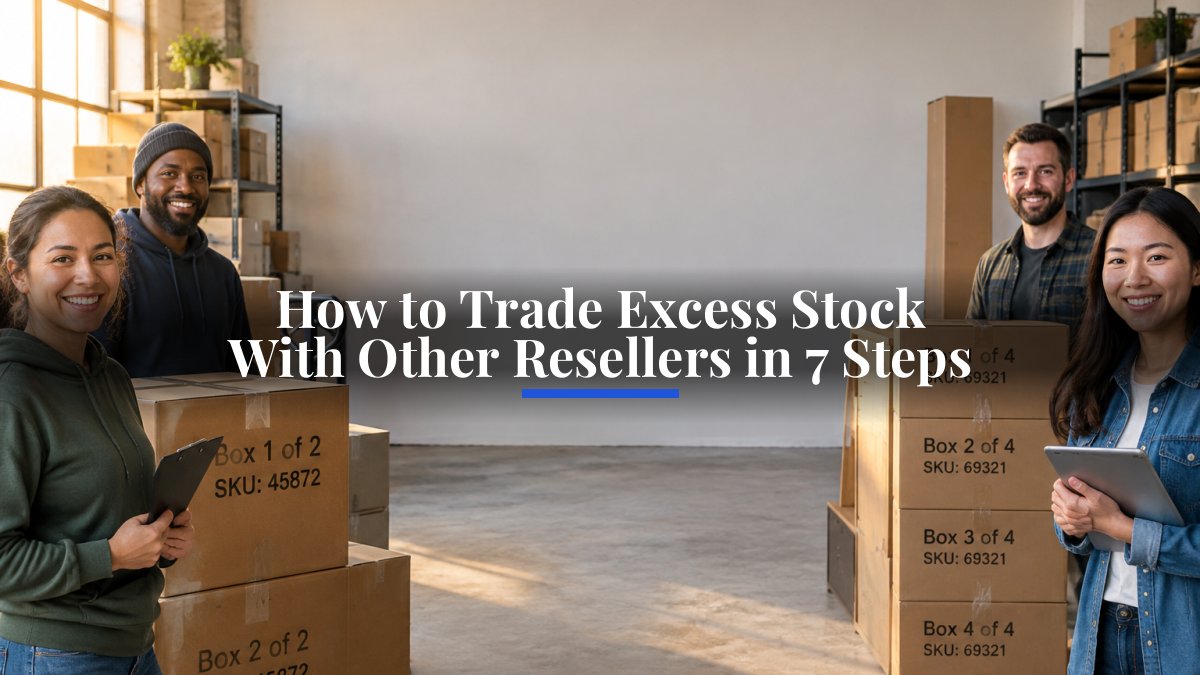
How to Trade Excess Stock With Other Resellers in 7 Steps
Quick Summary
To trade excess stock, sort and count your partial pallet, write an honest listing, find resellers who hold the missing pieces, vet them, agree on terms in writing, then complete a safe in-person exchange. Matching on a platform like Find The Other Box makes finding those partners faster.
- Sort, count and note exactly which box or piece is missing before you publish any listing.
- Describe condition honestly and include clear photos so buyers can verify items in person.
- Look for resellers who already hold duplicates of the piece you need.
- Put price, payment, quantities and cancellation terms in writing before any meetup.
- Meet in a busy, public place during daylight and count everything together before handing items over.
Table of Contents
- Why Partial Pallets Sit Unsold and Who Can Use Them
- Step 1: Sort and Count What You Actually Have
- Step 2: Check Condition and Write an Honest Listing
- Step 3: Find Resellers Who Hold the Missing Pieces
- Step 4: Vet Local Partners Before You Agree to Anything
- Step 5: Agree on Price, Payment, and Split Before You Meet
- Step 6: Meet in Person and Complete the Exchange
- Your Next Set to Match on Find The Other Box
- Frequently Asked Questions
Why Partial Pallets Sit Unsold and Who Can Use Them
Last Updated: November 14, 2026
Partial pallets are some of the hardest inventory to move. A pallet that is missing one box, one part or one piece of a set often looks like a bad buy to the next reseller.
- Resellers missing one component of a multi-box set
- Online sellers who need a matching item for a listing
- Bin store owners trying to complete a display or bundle
- Individual buyers who want a full set at a fair price
The catch is that these buyers rarely find you on their own. The steps below show how to sort your stock, list it honestly, find the right partners, agree on terms and complete a safe exchange.
Step 1: Sort and Count What You Actually Have
Before you list anything, sort your partial pallet into clear groups. Count each item, note the quantity and set it belongs to, and write down what is missing.
Good records save time. A buyer who sees an accurate count trusts you more and asks fewer questions before agreeing to meet.
- Group items by set or product line
- Count every unit and write the number down
- Note which box or piece is missing (for example, "Box 2 of 3")
- Take a photo of each group for your records
Watch out: a count that is off by even one unit can kill a deal at the meetup. Recount before you publish.
Step 2: Check Condition and Write an Honest Listing
Inspect each item for damage, missing packaging and signs of wear. Write down the condition in plain words. Buyers need to know exactly what they are getting, and an honest description prevents disputes later.
Describe the items in a way that a buyer can verify with their own eyes at the meetup. Avoid vague terms like "great condition" without detail.
- State the condition of each group ("new in box," "opened, all pieces present," "minor box wear")
- List the exact set details and what is missing
- Include clear photos of the front, back and any damage
- Mention any packaging or labels that are missing
A listing that matches the physical pallet builds trust. Buyers who feel misled will not return for future exchanges.
Step 3: Find Resellers Who Hold the Missing Pieces
Your best match is a reseller who already holds the piece you are missing. Guidance on checking packaging, listings, and local resellers can help you locate those pieces.
Look at what other sellers are offering, not just what they are asking for. For a practical checklist for finding and screening local partners, review the vetting steps before you commit. A partner who has duplicates of your missing item is the strongest match.
- Search for the exact set name and box numbers
- Filter for resellers in your area to keep meetups simple
- Message sellers who hold duplicates of the piece you need
- Ask whether they would trade a matching item for one of yours
Step 4: Vet Local Partners Before You Agree to Anything
Before you agree to meet and trade excess stock, take a few minutes to check the other reseller. A short vetting process protects your stock and your time. For in-person trades between individual resellers, a short check before you agree to meet can save a wasted trip. A quick check is especially useful when the stock is part of a series, since confirming what is missing can make a trade more worthwhile; Remember When Shop can help you think through that same kind of inventory search.
Run a quick profile check
Start with what the platform already shows you:
- Profile history: Look at how long the account has been active and whether it has completed trades or sales. A new account is not automatically a red flag, but it means you should verify more carefully.
- Listing consistency: Check whether the items they are offering match the photos and descriptions in their other listings. Inconsistent details are a warning sign.
- Responsiveness: A serious partner answers questions directly and confirms quantities without prompting. Slow, vague, or evasive replies are a reason to slow down.
Ask the questions that reveal a serious partner
A short set of questions filters out casual interest and surfaces problems early:
- Exact items: Ask them to describe the exact items they are offering, including box numbers and condition.
- Photos: Request current photos of the pieces, not stock images, before you commit.
- Meetup plan: Confirm they have a clear plan for the time and place, and that they can commit to it.
- Trade history: Ask whether they have completed similar trades before.
Know the red flags
Walk away from anyone who pushes you to move fast, skip details, or change the terms at the last minute. Common warning signs include:
- Refusing to send current photos or answer basic questions about condition
- Pressuring you to meet immediately or outside public hours
- Changing the quantity or price after you have agreed
- Asking you to hand over stock before inspection or payment
- Avoiding a written confirmation of the terms
Trust your instincts, but back them with a checklist. If something feels off, it is fine to pass and find another partner, there is always another reseller who needs the piece you are holding.
Step 5: Agree on Price, Payment, and Split Before You Meet
Settle the terms in writing before you bring any inventory to the meetup. A template of clauses for price, payment, and split can help you put these terms in writing. For individual resellers trading partial pallets, the goal is not to squeeze the last dollar out of a single box, it is to complete a set quickly, at a fair value, with no surprises in the parking lot.
Value the pieces before you name a number
A simple approach to pricing a partial pallet for trade is:
- Start from the set value, not the piece value. A complete set often sells for more than the sum of its individual boxes. Estimate what a full set sells for in your local market, then work backward, adjusting for condition and demand.
- Apply a condition and age discount. New-in-box pieces hold value; opened, shelf-worn, or older stock does not. Opened items usually carry less value than sealed ones, and stock that has sat for a long time may be worth less still.
- Set a walk-away number. Decide the minimum you will accept before you negotiate, so you are not making that decision under pressure at the meetup.
For a straight swap, compare the two sides using the same method. If the values are close, a one-for-one trade is fair. If one side is clearly worth more, balance it with an extra piece, a cash difference, or a future trade credit.
Write the terms down
Keep the agreement simple but specific. A short message that both sides confirm is enough for most small trades.
- Trade or sale: Decide whether it is a straight swap, a swap plus cash, or a cash sale
- Price or split: Write out the exact amounts or the percentage each side receives
- Payment method: Agree on cash, app payment, or another method before the meetup
- Quantities: List the exact count of each item changing hands
- Condition: Restate the condition of each item so there is no dispute later
- Cancellation: Agree on what happens if one side cannot make it
Protect yourself against no-shows and disputes
Small in-person trades can carry risk. A few simple controls can help:
- Confirm the day before. A short message the day before the meetup filters out casual interest and reduces no-shows.
- Hold the trade until both sides have inspected. Never hand over your stock before the other person has counted and checked the items, and never accept a trade without doing the same.
- Use a written receipt. A photo of the items plus a short message confirming the exchange can serve as a simple record. For larger trades, a simple signed note listing the items and the agreed value protects both sides.
- Agree on returns before the meetup. For in-person trades, the usual practice is final sale after inspection. If you agree to a return window, write it down.
Watch out: never hand over your stock before payment or the agreed trade is confirmed on both sides, and never let a buyer rush you past the inspection step, that is when counts and condition disputes happen.
Step 6: Meet in Person and Complete the Exchange
Choose a public, well-lit place during business hours. Many resellers pick a busy parking lot or a store entrance. Bring a friend if you can, and tell someone your plan before you leave.

At the meetup, count the items together, check the condition and confirm the payment or trade before anything leaves the car. Take a photo of the final count for your records.
- Meet during daylight hours in a busy, public spot, and use a safe meetup spot checklist to choose a well-lit location with clear sightlines.
- Count each item out loud with the other person
- Verify payment or trade items before handing anything over
- Photograph the final count and both sides of the exchange
- Send a short follow-up message confirming the deal is complete
Your Next Set to Match on Find The Other Box
Partial pallets do not have to sit in storage. Find The Other Box connects liquidation resellers who hold incomplete sets with the people who need the missing pieces. Browse listings near you, post your own partial sets and start matching today.
See how Find The Other Box connects resellers so you can find the missing pieces for your own partial sets and turn stranded inventory into sales. Start matching for free and get your next set complete.
Frequently Asked Questions
What should I do with excess stock that nobody is buying?
Start by listing the partial sets on a platform built for trading, such as Find The Other Box, where other resellers search specifically for the missing pieces. Be specific in your listing: state the set number (Box 1 of 2, Box 2 of 3), the exact item names, and the condition of each piece. A reseller who needs one more box may be a more natural buyer for a component of a set than a general buyer. If a set still does not move after a few weeks, consider offering the whole set at a lower price to a single reseller, or bundle it with another partial set that complements it.
How do I find another reseller who has the missing items in my set?
Search for the exact item names, model numbers, and set numbers you need, rather than general categories. Check whether your local resale groups or a matching marketplace list the pieces you are missing. Post a specific request stating what you need, what you can offer in return, and your local area, since most of these exchanges happen in person. Respond quickly to replies and confirm the details in writing before you travel anywhere.
What information should I share when offering inventory for trade?
Share the item names, quantities, set numbers, and the condition of each piece, including any damage, missing packaging, or untested electronics. Include clear photos of the actual items you will hand over, not stock images. State your asking price or trade terms, your general location, and when and where you are available to meet. Accurate details reduce disputes at the exchange and help the other reseller decide quickly.
How can I check the condition and completeness of inventory before trading?
Count every unit against your inventory sheet and mark any that are damaged, opened, or incomplete. Test electronics or working items where possible and photograph each one with its condition noted. Before the meeting, ask the other reseller to share photos of their pieces too, so you can confirm they match the description. Agree on what counts as an acceptable return or dispute before you exchange anything.