 how-to
Resale Strategies for Mismatched Product Sets
Last Updated: October 25, 2026
Quick Summary
Resale strategies for mismatched product sets involve four paths: selling as-is at a steep discount, splitting and selling components individually, recombining into themed bundles, or matching with other resellers to complete sets. The highest-recovery approach is matching with nearby resellers who have the missing pieces you need, turning two incomplete sets into one complete, premium-priced product.
- Matching incomplete sets with other resellers recovers 80-90% of complete product value, compared to 20-30% when selling as-is.
- Before choosing a resale path, catalog your partial inventory with exact box numbers, missing components, and condition to enable effective matching.
- Local in-person exchanges require verifying item count, condition, component presence, and safety recalls before completing any trade.
- Individual components sell best separately when they are recognizable brands or popular items with strong standalone demand.
- Document every trade with photos and follow-up messages to build repeat trading relationships with reseller partners.
Table of Contents
- Understanding the Challenge of Mismatched Product Sets
- How to Sell Incomplete Product Sets
- Selling Products Individually vs. in Bundles
- Matching Liquidation Inventory with Other Resellers
- Local Reseller Inventory Exchange Best Practices
- Pricing and Valuing Partial Inventory
- Start Matching Your Inventory Today
- Frequently Asked Questions
Understanding the Challenge of Mismatched Product Sets
Incomplete product sets are a constant headache for liquidation resellers.
This is where resale strategies for mismatched product sets become critical. Find The Other Box is designed to help resellers facing this problem daily.
Most resellers approach this wrong, discounting incomplete sets and hoping someone buys them as-is. The smarter move is to treat your partial inventory as a trading asset. You can learn more about safety considerations before engaging with other resellers on inventory matching.
The real opportunity lies in connecting with other resellers who have the missing pieces you need. When two incomplete sets become one complete set, both resellers win.
How to Sell Incomplete Product Sets
When you have incomplete inventory, you have four main paths forward. The useful part is the decision rule: which path fits this specific set, this week, given your space, cash, and calendar. Below is the framework experienced individual pallet buyers use before a partial set eats another month of storage.
Path 1: Sell As-Is at a Steep Discount
You list the incomplete set for significantly less than the complete version.
Pros:
- Clears storage space immediately
- No coordination needed with other sellers
- Simple listing process
Cons:
- Lowest recovery value of the four paths
- Requires aggressive pricing to attract buyers
- Ties up capital with minimal return
Path 2: Split and Sell Individually
Disassemble the set and sell each component separately.
Pros:
- Often recovers meaningfully more than as-is pricing
- Reaches buyers looking for specific items
- Faster turnover on individual pieces
Cons:
- More time spent photographing and listing
- More transactions, so more fees and more buyer messages
- Only works if each piece has standalone appeal
Path 3: Recombine with Other Partial Sets
Pros:
- Better margins than selling as-is
- Attracts bargain hunters and other resellers
- Moves multiple problem items at once
Cons:
- Requires creative listing descriptions
- May still not appeal to mainstream buyers
- Returns and disputes increase with bundles
Path 4: Match with Other Resellers
Find another individual pallet buyer who has the exact pieces you are missing.
Pros:
- Highest recovery value of the four paths
- Sells as a complete, premium-priced product
- Builds a network of resellers you can trade with again
Cons:
- Requires finding the right match
- Coordination and meeting logistics take time
- Trust and verification are essential
The Decision Rule: Four Questions Before You Choose a Path
Run every partial set through these four questions in order. Stop at the first "yes" that points to a path.
-
Is the set complete-able? If the missing component is common and another individual pallet buyer nearby likely has it, go to Path 4 first. If it's rare, discontinued, or region-specific, matching may take months, treat it as Path 1 or 2.
-
Do the components have standalone demand? Check completed-sale history on your marketplace. If individual pieces sell regularly, Path 2 usually beats Path 1. If components are generic or low-value, splitting just multiplies listing work.
-
What is your storage cost per week? If the set occupies shelf space you need for incoming pallets, waiting has a real cost. A set that sits two months for a modest recovery bump may still be a net loss once you count the blocked space.
-
Do you have a match partner within driving distance? Path 4 only works if you can meet in person. If the nearest plausible match is shipping-only, factor in packing time, carrier risk, and the chance the other party's description was optimistic.
What to Do First, This Week
Each path forward has distinct tradeoffs in recovery value, time investment, and storage impact.
| Path | Best For | Key Advantage | Main Drawback |
|---|---|---|---|
| Sell As-Is at Steep Discount | Clearing space immediately | No coordination needed | Lowest recovery value |
| Split and Sell Individually | Components with standalone demand | Often recovers more than as-is | More listings and buyer messages |
| Recombine into Themed Bundles | Items with weak individual appeal | Better margins than as-is | May not appeal to mainstream buyers |
| Match with Other Resellers | Complete-able sets with nearby partners | Highest recovery value | Requires finding right match |
Selling Products Individually vs. in Bundles
The choice between individual and bundled sales depends on your inventory composition and buyer demand, a crucial decision point for maximizing recovery on mismatched product sets.
When to Sell Individually
Sell components separately when each item has strong independent demand.
Individual sales work best when:
- Components are recognizable brands or popular items
- You can photograph and list each item quickly
- Marketplace fees are reasonable relative to item value
When to Bundle
Bundle items when individual pieces have weak standalone appeal.
Bundle when:
- Individual items are hard to price or list
- You want to clear space fast
- You're targeting other resellers as buyers
The Math Behind the Decision
If you have 10 incomplete sets taking up space, selling individually might recover more total dollars but requires 30-40 separate listings. Bundling the same inventory into 3-4 themed lots takes half the time and still recovers 60-75% of complete set value.
The real question isn't which method is "best", it's which fits your operation. Do you have time to manage dozens of listings, or do you need to clear space and move on?
Matching Liquidation Inventory with Other Resellers
This is where resale strategies for mismatched product sets get powerful.
Matching works because resellers operate independently, one person's "Box 1 of 2" is another person's missing piece.
How Matching Creates Value
You have 50 incomplete sets worth $500 total at discount pricing; another reseller has 30 different incomplete sets worth $300.
The matching process requires three things: finding the right partner, verifying the match, and executing the exchange. Find The Other Box connects you with other resellers who have the specific components you're looking for.
Finding Reseller Partners
Start by identifying what you're missing, specific items, models, or box numbers. Then search for resellers whose inventory complements yours, especially those specializing in similar categories or buying from the same liquidation sources.
Online communities, marketplace forums, and dedicated reseller networks are where these connections happen.
Building Trust in Reseller Networks
You're potentially exchanging inventory with someone you've never met. Verification is non-negotiable.
Local Reseller Inventory Exchange Best Practices
Meeting in person to exchange inventory eliminates shipping risk and builds trust.
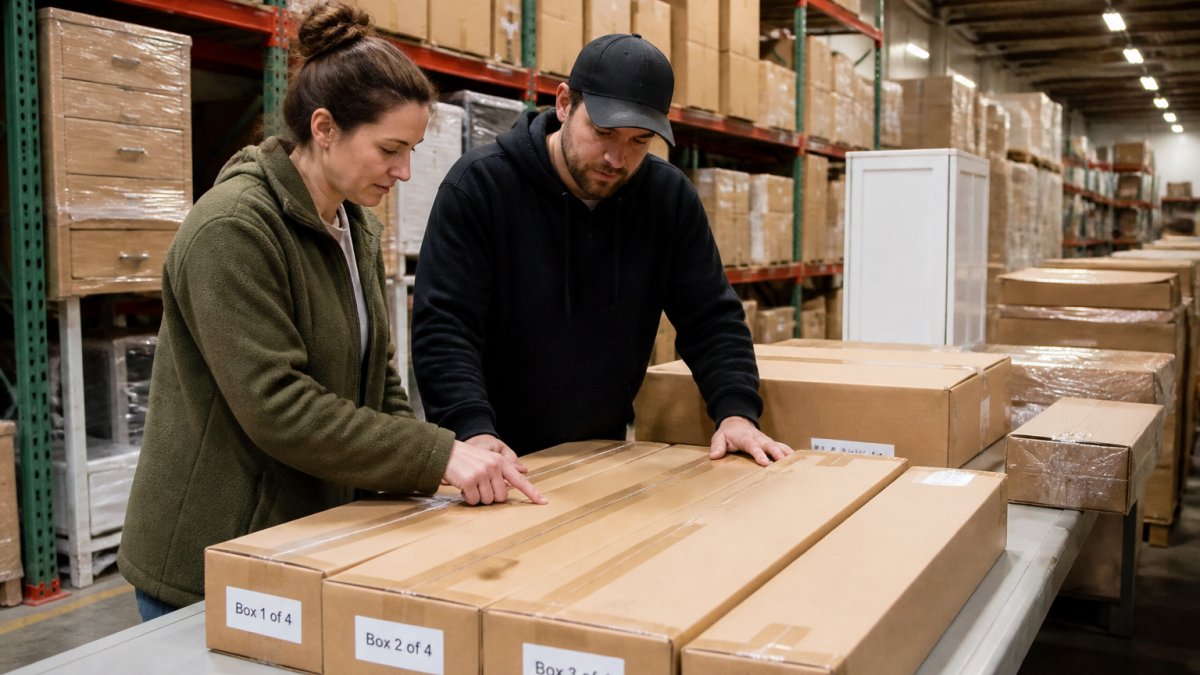
Before the Meeting: Finding and Qualifying a Match Partner
Start with your catalog list.
Then look for partners in three places:
- Local reseller groups and marketplace forums where individual pallet buyers post what they have and what they need.
- Dedicated matching tools that let you search by box number or component rather than by product category.
- Repeat contacts, the reseller you traded with last month is the fastest person to ask first.
Qualify the partner before you commit to a meeting.
Setting Up the Meeting
Agree in advance on:
- What is being traded, item by item
- Condition standards (new, open-box, tested, for-parts)
- Whether the trade is even or one side pays the difference
Bring your inventory in labeled boxes or bins so both parties can inspect efficiently.
What to Verify Before Completing a Trade
Before you hand over your inventory, confirm five things together, out loud:
-
Item count matches the agreement. Count everything together. Do not assume, verify.
-
Condition is as described. Open boxes, check for damage, and test items if possible. Mismatched product sets often carry condition issues that were not obvious in photos.
-
All components are present. If you are trading for "Box 2 of 2," make sure it actually contains Box 2 and not a substitute. Check serial numbers or model numbers where applicable.
-
No recalls or safety issues. Do a quick search for product recalls on anything you are receiving. This protects both parties and is especially important for electronics, children's products, and anything with a power supply.
-
Both parties agree on the exchange terms. Document what was traded, quantities, and condition with a photo or a short written note. A timestamped photo of the laid-out items prevents most later disputes.
After the Trade: Close the Loop
Once you are home, update your catalog immediately, mark the set complete, note the source partner, and record the condition.
Pricing and Valuing Partial Inventory
Pricing incomplete sets requires a different mindset than pricing complete products.
Discount Pricing for Incomplete Sets
A complete product set might retail for $100. An incomplete set (missing one component) typically sells for 30-50% of that value.
When two incomplete sets combine into one complete set, the combined value should reflect the complete product value minus a small reseller discount (10-15%). You're not selling retail, you're facilitating a reseller transaction.
Understanding Your Recovery Rate
Recovery rate is what percentage of the original complete-set value you get back. Selling as-is: 20-30% recovery. Selling individually: 50-70% recovery.
The higher recovery rates justify the extra effort of finding matches.
Factoring in Your Time and Effort
Don't ignore the cost of coordination.
Start Matching Your Inventory Today
The resellers who thrive with mismatched product sets are the ones who actively build networks and seek matches. You have incomplete inventory sitting in your space right now.
The first step is getting organized. Then start searching for matches. Contact the Find The Other Box team to ask questions about matching strategies or share your inventory needs.
Find The Other Box connects resellers like you with others who have the exact pieces you're looking for. Our matching engine simplifies finding matches.
The resale strategies for mismatched product sets that work best combine three elements: realistic pricing, active searching, and verified partnerships. When you apply all three, incomplete inventory transforms from warehouse clutter into profit.
Frequently Asked Questions
How do you sell a product set when some pieces are missing?
You have three main options: sell the incomplete set at a reduced price with transparent disclosure of what's missing, sell the individual components separately for potentially higher total revenue, or find another reseller with the matching pieces to complete the set before selling. The best choice depends on market demand for the incomplete item, how much the missing components cost to source separately, and whether you have time to find a matching partner. Many resellers use dedicated marketplaces to connect with others holding complementary partial inventory.
Should mismatched products be sold individually or as a bundle?
Sell individually if the components have strong standalone demand and resale value, or if the items are from completely different product lines. Bundle them if they form a recognizable set that buyers actively search for, even if some pieces are missing or mismatched. Test pricing both ways on your marketplace to see which generates faster sell-through. For liquidation inventory, bundling often moves stock faster despite lower per-unit margins, while individual sales may recover more total value if components are in demand separately.
How can resellers find the missing pieces for incomplete sets?
Connect with other liquidation resellers through dedicated matching platforms, local reseller groups, or community networks who may have the exact components you need. Clearly document what you're missing, include the product name, brand, set number, and which specific pieces you need. When reaching out, be specific about condition requirements and your timeline. Many resellers manage partial inventory specifically to complete sets for others, making these connections mutually beneficial for both parties.
What should you agree on before meeting another reseller to exchange inventory?
Confirm the exact components each person is bringing and verify they match what was discussed. Agree on inspection procedures, will you test items, check packaging, or verify serial numbers on site? Discuss pricing or trade value beforehand so there are no surprises. Establish a clear meeting location and time, and consider meeting in a neutral public space. If payment is involved, agree on the method in advance. Document what's being exchanged with photos or a simple written note so both parties have a record.
Stop treating incomplete sets as losses. Start treating them as trading assets. The reseller who completes your sets is out there right now, looking for exactly what you have.