 how-to
5 Steps to Resell Incomplete Amazon Inventory Sets
Last Updated: October 26, 2026
Quick Summary
Resell incomplete inventory by finding another reseller who has the missing pieces. When two partial sets meet, they can become complete, allowing you to recover value through matching rather than selling as-is or parting out.
- Document exactly what's missing, what's included, and condition before attempting to match sets.
- Use a three-number comparison to assess as-is value, completed-set value minus sourcing cost, and part-out value.
- Verify compatibility with photos and model numbers before committing to an in-person meetup with a potential match.
- Meet in a public place with good lighting to inspect both partial sets side by side before exchanging.
- Keep records and documentation of the completed set after the exchange is verified and finalized.
Table of Contents
- Why Incomplete Sets Become Stranded Inventory
- Step 1: Assess and Grade Your Incomplete Product Sets
- Step 2: Handling Amazon Unfulfillable Inventory
- Step 3: Price Your Incomplete Sets Realistically
- Step 4: Find Partners by Matching Partial Inventory
- Step 5: Complete the Exchange Safely and Verify Sets
- Start Matching Your Incomplete Sets Today
- Frequently Asked Questions
Why Incomplete Sets Become Stranded Inventory
Incomplete product sets sit in warehouses and storage units, tying up capital. A box labeled "2 of 3" or "missing components" can be difficult to sell through traditional channels.
The real problem isn't the inventory itself, it's that you're trying to sell it alone.
Resell incomplete inventory by finding another reseller who has the missing pieces. When two partial sets meet, they can become complete.
This is where reselling incomplete Amazon inventory sets becomes a strategy: matching connects you with peers who have missing pieces.
At Find The Other Box, we've built a marketplace for exactly this. Our matching engine connects resellers with complementary partial inventory.
Step 1: Assess and Grade Your Incomplete Product Sets
Before you can match anything, you need to know exactly what you have. Vague descriptions kill deals.
Document each incomplete set: what's there, what's missing, and any damage or wear. This becomes your grading foundation.
Document what's missing
Don't write "missing parts." Write "missing the power adapter, USB cable, and instruction manual." Name and count each missing component, and describe condition where duplicates exist (e.g., "two of three batteries included, one shows corrosion").
Distinguish essential from optional: a missing manual differs from a missing power cord, and a decorative insert differs from a core component. Your matching partner needs to understand this.
Evaluate condition and sellability
Grade each incomplete set on a simple scale. You're not creating a formal certification, you're being honest about what a buyer will receive.
Consider these factors:
- Original packaging: Is it intact, damaged, or missing?
- Component condition: Are items new, lightly used, or heavily worn?
- Functionality: Do the included items work, or are they untested?
- Completeness of what's there: Are all included items in the box, or are some loose or missing?
- Cosmetic issues: Scratches, dents, discoloration, or stickers?
Write a brief condition summary. Example: "Box 1 of 2, original packaging intact, all included components unused, missing Box 2 and instruction manual."
Be realistic: if the included components are damaged or the missing parts are critical to function, recovery value may be too low to justify the storage space and effort.
Sort missing components by their impact on the set's value and function.
| Component Type | Impact | Example |
|---|---|---|
| Core or proprietary | Deal-breaker if missing | Main unit, custom bracket, matched pair |
| Functional but replaceable | Important but sourced easily | Cables, adapters, standard accessories |
| Cosmetic or optional | Minor gap | Manuals, inserts, decorative packaging |
Step 2: Handling Amazon Unfulfillable Inventory
The key decision: reselling incomplete sets only works if you can recover the inventory and verify its condition yourself. Amazon's fulfillment centers can't do this for you, you have to own the grading and matching process. Learn broader reselling strategies for overstock and incomplete liquidation sets beyond Amazon inventory.
Step 3: Price Your Incomplete Sets Realistically
Incomplete sets aren't worth full retail, but they're worth something. How much less depends on your plan: sell as-is, trade for a matching partial, or part it out.
A three-number comparison can help you assess a partial set before committing to a deal. Write the numbers down so you're not negotiating from memory.
The three-number recovery check
For any incomplete set, estimate three values:
-
As-is resale value. What a buyer would pay today for the set as it sits, missing components disclosed. Check sold listings on eBay and Facebook Marketplace for similar condition, not asking prices. If nothing comparable exists, discount from the lowest sold price for a heavily used complete set.
-
Completed-set value minus your sourcing cost. What the set sells for once complete, minus what it costs to acquire the missing components by buying them or trading another partial set you own. This is your ceiling for what the match is worth.
-
Part-out value. What the included components would fetch sold separately. This is often the floor; if the sum of the parts beats the as-is value, parting out may beat matching, especially when the missing piece is rare or expensive.
Whichever number is highest tells you which path to pursue: as-is resale, pursue a match, or part it out.
Pricing for a trade, not a sale
When matching with another individual reseller in person, you may be setting trade terms rather than a cash price. Two partial sets of the same product may differ in value.
Be explicit before you meet: state what you have, what you're missing, and what the trade should look like.
Factor in condition and missing-part criticality
Before you name a number, sort missing components into three buckets:
- Cosmetic or optional: manuals, inserts, decorative packaging.
- Functional but replaceable: cables, adapters, standard accessories.
- Core or proprietary: the main unit, a custom bracket, a matched pair component.
Write the bucket next to each missing item. When a partner asks what you're missing, you can say instantly whether it's a deal-breaker or a minor gap.
Don't anchor to retail
Retail price is a reference point, not a valuation. Let sold data and replacement cost inform your assessment.
Step 4: Find Partners by Matching Partial Inventory
This is where the real work begins. The challenge is finding another individual reseller with your missing pieces and confirming that what they have completes what you're missing.
You can search reseller communities and forums for a potential match.
Build a completeness checklist before you search
Before contacting anyone, turn your documentation into a checklist for verifying a match. For each set, list:
- Every component that should be in a complete set (use the manufacturer's parts list, the retail box contents, or a sold listing photo as your reference)
- Which components you have, with condition notes
- Which components you're missing, sorted by criticality (core, functional, cosmetic)
- Any model numbers, lot codes, or revision markers that affect compatibility
Product sets may have multiple revisions, and a component from a different revision may not fit or match cosmetically. Note your revision and ask your partner for theirs before you meet.
Verify compatibility before you commit to a meetup
When you find a potential match, run a short verification pass before agreeing to meet: Learn how to safely verify sellers and evaluate inventory conditions before committing to a match.
- Ask for photos of their partial set, including close-ups of the components you need
- Confirm the model number and revision match yours
- Check their condition descriptions against your own standards
- Ask whether the components have been tested or are untested
- Confirm quantities, especially for sets with multiples of the same item
If anything is unclear, ask for another photo before deciding whether to meet.
Sourcing replacement components when no match exists
When you source a replacement, verify it against your checklist the same way you would verify a partner's inventory. Test it if possible. Photograph it. Add it to your documentation so the completed set has a clean history.
Agree on logistics before the meetup
Once you've confirmed compatibility, agree on the practical details in writing:
- Who travels, and how far
- Where you'll meet (a public place with good lighting and space to lay out both sets)
- What each person brings (the partial set, documentation, any cash difference)
- What happens if a component doesn't match the photos
- How you'll handle a partial trade if one side is short
A short message thread covering these points can help clarify the terms before you meet.
Learn how to recover value from partial inventory by matching incomplete sets with other resellers
Discover the core strategy for matching incomplete sets with other resellers to complete pairs
Step 5: Complete the Exchange Safely and Verify Sets
Meeting in person lets you see the inventory, verify components, confirm condition, and count items.
Pick a neutral, safe location, a public place with good lighting works best. Bring your documentation, photos, condition notes, and component lists.
When you meet, do this:
- Lay out both partial sets side by side
- Check each component against your documentation
- Verify quantities match
- Inspect condition in person
- Test functionality if possible
- Take photos of the completed set together
- Document any discrepancies before exchanging
Take your time. This isn't a quick handoff. Verify everything before exchanging.
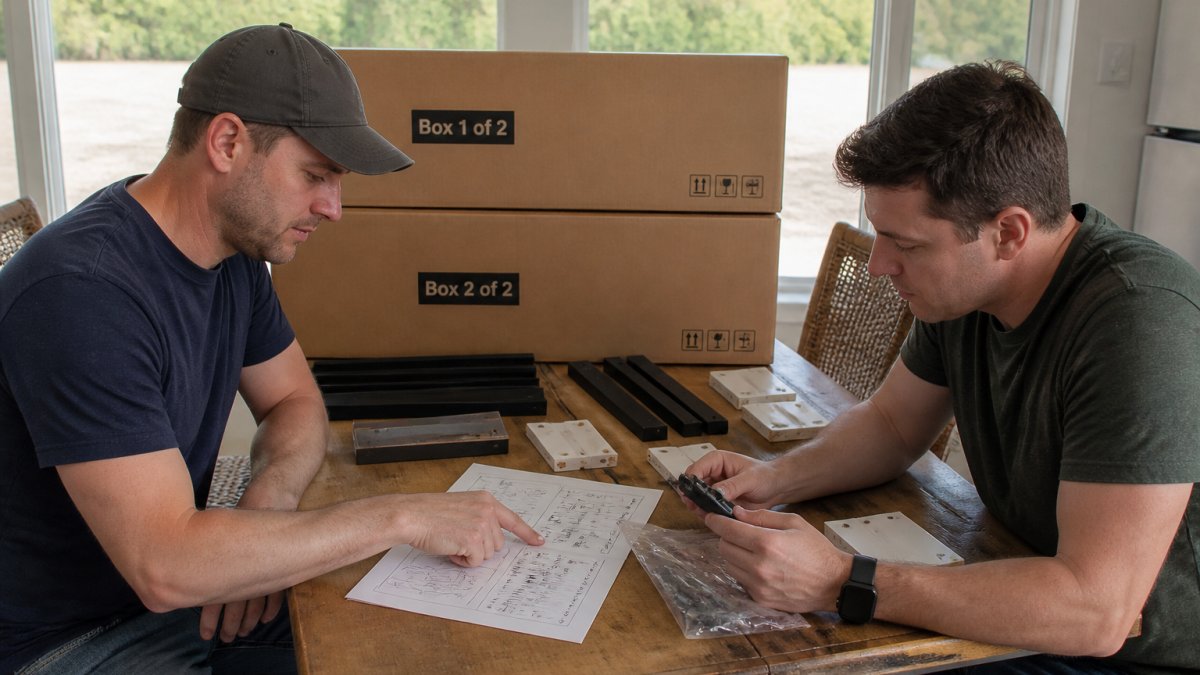
Once everything matches your agreement, complete the exchange and keep records of the transaction. Understand how to manage returns and disputes after completing a matched inventory exchange.
Understand how to manage returns and disputes after completing a matched inventory exchange
Start Matching Your Incomplete Sets Today
Matching incomplete sets can connect resellers who have complementary inventory.
Finding a partner with the missing pieces can be a challenge.
Find The Other Box is a marketplace that connects users with complementary partial inventory.
Start matching for free.
Frequently Asked Questions
What should I do with incomplete Amazon inventory sets?
Start by documenting what's missing from each set and assessing the condition of what remains. You can look for a matching partner through a dedicated marketplace or reseller community. Find The Other Box connects users who have partial inventory with those who have the missing pieces.
How can I find the missing pieces for a partial inventory set?
You can look for other individual resellers with complementary partial sets through reseller communities and forums. Find The Other Box is a marketplace designed to connect users who have partial inventory with those who have the missing pieces.
Can incomplete products be resold on Amazon?
Whether incomplete products can be sold on a particular marketplace depends on that marketplace's current policies. Find The Other Box connects users who have partial inventory with those who have the missing pieces.
How should resellers document and verify a set before exchanging items?
Document the components included in your partial set. When meeting another reseller, you can inspect the items together and check whether the pieces fit together. Find The Other Box connects users who have partial inventory with those who have the missing pieces.
Incomplete inventory doesn't have to be a loss. When you connect with the right reseller and verify your sets in person, both of you recover real value. Find The Other Box makes that connection simple. Start matching your incomplete sets today and clear your warehouse while recovering your investment.